
My private list of bookmarks on Google Maps, titled “Want to Go,” contains over 231 pins. These range from parks and birding spots to coffee shops and book stores and interesting restaurants, plus everything in between. The criteria to make this list is very minimal—sometimes it’s a place recommended to me or somewhere I want to visit again, or sometimes I just zoom in randomly on a map and bookmark the first place I see.
Seneca Rocks is one of the 231 pins, added last summer after my friend casually mentioned how her family camps there. I rediscovered it when planning my next trip, which I do in an equally haphazard way by panning around on a map and clicking stuff at random. I looked at precisely two pictures before texting my partner “will you go camping at Seneca Rocks with me sometime?”
I talked him into going for our next trip in October (“think of the fall colors!!”), which we’d both blocked off on our calendars but not technically planned. We spent the following Tuesday browsing campsites and looking at hikes before making a reservation. After a brief mishap where our campsite was selected on his computer and thus unavailable on mine, causing me to angrily curse the loser that stole our campsite mere seconds before we booked it, we were all set.
Day 1
Just like Cape May, I packed up my car the night before, so my Friday departure could be straight from the office. This time it was considerably later at night, as my boyfriend was watching the Red Sox lose the wild card game to the Yankees. I was maybe a little tired and grumpy, but we managed. The next day I picked him up from the closest metro stop to my work. We both surveyed the packed car, ensured that we had everything (not that it would make much of a difference at this point), and trudged west in a sea of brake lights.
Once we got out of commute traffic and a confusing spiderweb of toll roads and express lanes, on which I accidentally racked up some charges, the drive was easy. We’d be setting up camp in the dark anyway, so we weren’t in any particular hurry. I put my passenger princess in charge of finding us dinner. He suggested a place called Spelunker’s in Front Royal, which would be about a 17 minute-detour, based on nothing except “I’ve heard it’s good” from no definitive source. That sounded like my kind of planning, so we pulled into the last available spot of a tiny, cramped parking lot at around 6pm.
The restaurant was painfully crowded with no clear line, just a mass of people by the counter gesturing to one another—“you were here first,” “no really, go ahead”—whenever a register became available. When we finally made it to the front, we both ordered a burger and a “world famous” Spelunker’s milkshake. I don’t know about world famous, but the food was good. I’d been meal prepping (read: eating sad leftovers) all three meals a day all week, so I scarfed down my burger like a starved, rabid dog. Luckily, we sat outside and at the edge of the patio, so there were no terrified small children or appalled middle-aged women to judge me. My chocolate shake was the eat-with-a-spoon kind and my partner had recently introduced me to malt vinegar on fries, which tastes fantastic. I made sure to warn friends and family I’d be out of service for the weekend before we stopped by a gas station and hit the road again.
The drive was long and uneventful. The closer we got to West Virginia, the more hilly the terrain got, the road wiggling across the landscape in a series of steep climbs and equally sharp drops. Signs warned trucks of 8% grades. A much friendlier sign, reading “Welcome to West Virginia!” greeted us at the top of one of these hills, so we cheered and promptly queued Country Roads. It played in 3-5 second bursts due to lack of service, so we filled in the rest with our tone-deaf singing.
I missed the vastness and emptiness of rural Western nights, so was happily surprised to find the same in West Virginia. The sky was mostly devoid of stars, and towns were few and far between. The denseness of the forests and looming hills gave it a more eerie feel than I was used to. Hugged on either side by an impenetrable wall of trees, the road felt cramped and claustrophobic.
“West Virginia sure is a hilly state,” I remarked, easing the car up yet another ridiculously steep grade.
“Well, out here we call these mountains,” was his reply. I stifled a laugh and he gave me a look as if daring me to argue.
We passed the time talking about work, then complaining about work, then working out the logistics of me being his plus one at a friend’s wedding in New England, which we sadly couldn’t reconcile with my lack of PTO. When we came across a stop sign and brightly lit little shop, I abruptly pulled in, looking for firewood. We got two bundles and a Seneca Rocks sticker for my collection.
We still had another 45 minutes to our campsite. Most of those were spent on a narrow, winding dirt road up the side of the ridge, with vicious potholes that were difficult to make out in the dark. I was extraordinarily freaked out by the oppressive darkness and thickness of the woods, fighting the urge to turn around and head back towards civilization. I half-expected to see a shadowy figure blocking the road around every corner, or a bloodthirsty bear in the rearview mirror. My boyfriend had to remind me that black bears are generally harmless and the bigger, more aggressive grizzlies aren’t remotely near us.
“But what if there’s a rogue POLAR bear at our campsite, vacationing from Alaska?” He didn’t have an answer to that one. Checkmate.
Our campsite was thankfully lacking polar bears at 9:15 when we pulled up. The only giant white object was the moon, nearly full. It shyly emerged from behind leafless trees once we set up our tent and got a fire going. It was beautiful, so I took one of the blurriest, bigfoot-sighting-esque iPhone photos of it shining through the trees. I guess some things are for our eyes only.
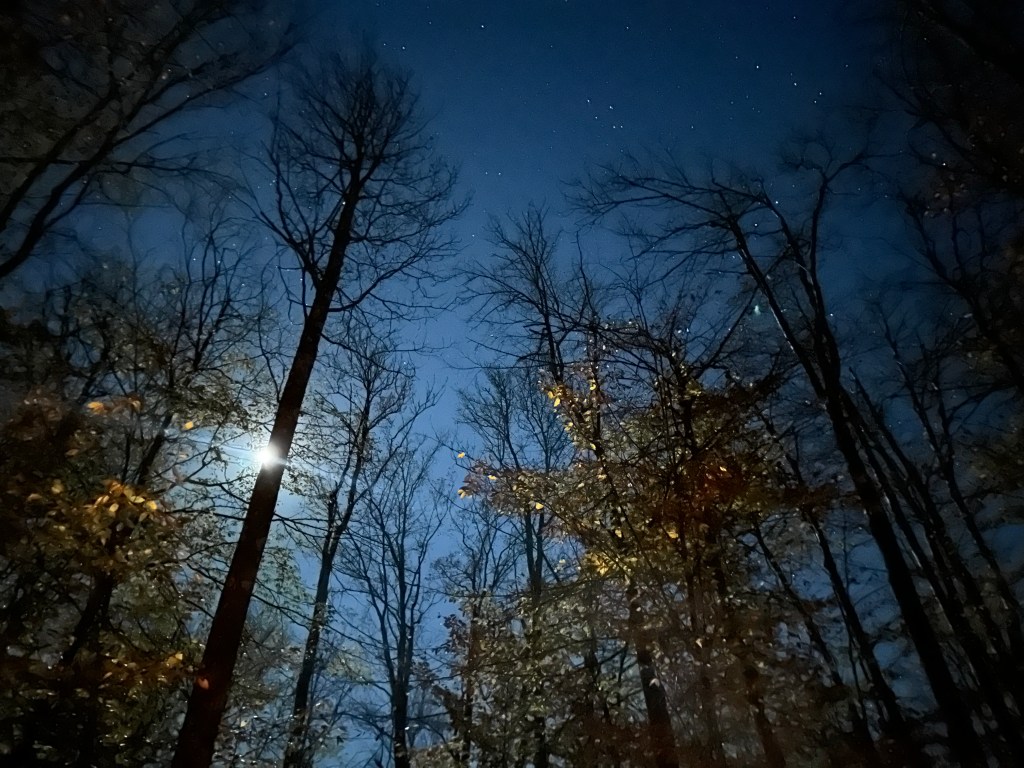
It had been a long day, and a little after 10pm felt sufficiently late enough to let the fire die and head to sleep. Smoldering embers emitted very little heat, so I quickly began to shiver. I wore long sleeves to bed for the first time since spring. My sleeping bag, borrowing from my boyfriend because I still don’t have one of my own, was nice and warm after a couple minutes, so I drifted off quickly.

Day 2
Throughout my camping trips this year, I’d hoped to find a whip-poor-will. Brownish and nocturnal, they’re not easy to spot, and you generally have a much better chance of hearing them. I’d been on the prowl for one ever since I missed them at the Wenas Audubon campout, where a large group of us silently staked out a hill after dusk. It was freezing cold and violently windy, so all we heard was one sad little whoop and nothing else for the rest of the night. Well, allegedly someone heard something. I did not.
So imagine my frustration when my boyfriend, after returning from a solo backpacking trip, texts me a recording of his campsite with the question “what is this?? it kept me up all night.” The stupid little thing sounded no more than 50 feet from the microphone. Another trip he awoke to a Yellow-bellied Sapsucker pecking his little heart out on the tree directly above him, but whatever. I’m not bitter about either of these at all.
The combination of being in a tent with my boyfriend (an established poorwill magnet) and on the East Coast meant I had Eastern Whip-poor-wills on the mind. Never mind the fact it was too late in the season and they were probably migrating south by now. So naturally, at 6:30am, the slightest noise outside had me awake in seconds and thrashing around like a crazy person. Through sleep-swollen eyes, I grabbed my phone and desperately stuck it outside the tent, trying to get a recording of my supposed poorwill. Morning air, damp and chilly, seeped into my unzipped sleeping bag. The soft chirping (mind you, which sounded literally nothing like a poorwill) was too faint to capture, so I kept cursing softly and wiggling around, as if the swish-swishing of the sleeping bag against the side of the tent was helping at all.
It took Merlin Sound ID displaying “Swainson’s Thrush” several times for me to realize why the noise was so familiar. Obviously it was a Swainson’s Thrush, a bird I should’ve recognized instantly, and a common morning visitor. I begrudgingly retreated into the tent and passed out again.
I got up for good a couple hours later, still groggy and confused. This weekend I’d resigned myself to getting a proper amount of sleep each night, for the sake of both my mental and physical health, but at the expense of sleeping through prime morning birding. I thought it important to be well-rested: the goal of this trip was to hike and enjoy the outdoors with my partner, not run around with a birding agenda. Plus, there would still be birds on our afternoon hikes.
My boyfriend took charge of the french toast while I boiled water for coffee. Now, we all know a watched pot never boils, which is why I spent that time running through the campground in pursuit of a Blue-headed Vireo. I successfully soaked through my shoes and terrorized our neighbors, but never got a glimpse of it. I’d seen one before in Shenandoah, but given the nature of vireos, it wasn’t a very good view. While I could add it to my year list, I’d probably need another season to get a decent look.

I measured the coffee grounds with my heart and not a tablespoon, so we had very strong coffee and lightly burnt french toast for breakfast. It was the best thing I’d ever tasted. The creepiness of the woods had evaporated in the crisp autumn morning, chased away by familiar bird sounds and smells of the outdoors. I heard the twittering of Dark-eyed Juncos for the first time since leaving the West Coast, and I unironically nearly cried with happiness. Black-capped Chickadees, Golden-crowned Kinglets, and Red-breasted Nuthatches jumped between bare branches in the tree canopy, while juncos, robins, and thrushes scratched in the leaf litter. A raven croaked distantly. The only difference was the raucous cawing of Blue Jays instead of Steller’s Jays, the crying of an Eastern Towhee instead of Spotted, and the whistling song of Blue-headed Vireos instead of Cassin’s. It felt like home, but not quite—almost heaven, one might say.
The level of effort we put into cleaning was disproportionate to the results. Our dishes were still slightly sticky with maple syrup and seasoned with dirt, which we wiped off with paper towels and deemed “good enough” before tossing in the car. As the crow flies, our campsite is decently close to Seneca Rocks. Unfortunately, as much as I like birds, I have yet to grow wings. After packing up our hiking gear, we loaded into the car instead for the 45-minute drive out. The ominous dirt road we climbed last night was glorious in the daytime, offering sweeping views of the valley and the whole range of fall foliage. The only mishap involved me hitting a pothole at full speed, after which I apologized profusely to both the car and my passenger, while, in the same breath, praying I hadn’t damaged anything. My car was dirty but fine, though I vowed to learn to change a tire after this weekend, just in case.
The Seneca Rocks parking lot was crowded but not overflowing. My partner and I looked like a walking REI ad, decked out in boots, baseball caps, convertible hiking pants (him), and a camo harness for binoculars (me). In a crowd including toddlers in flip-flops and couples in button-up shirts and dresses, we were woefully over-prepared. We commented on it, laughing a little, but didn’t really mind. It’s not like today’s hike was super strenuous, but we had the gear anyway, so it didn’t make sense to also pack a more casual set of hiking clothes.
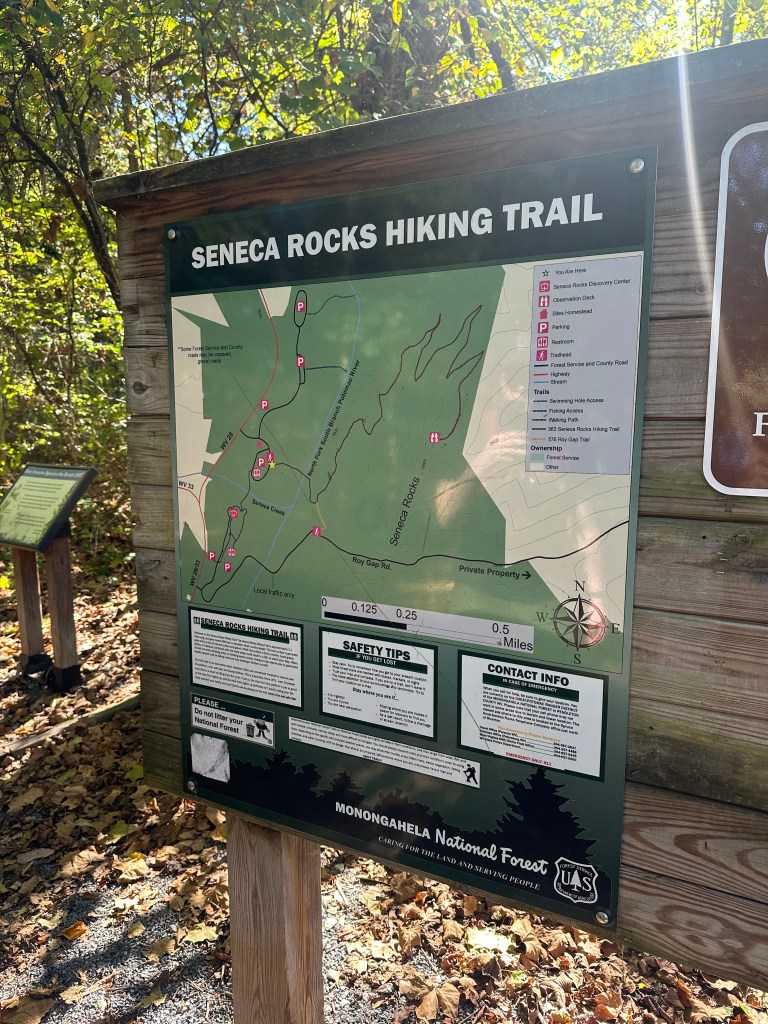
We made good time up the hill, despite the pit stops for birds. An active flock of Cedar Waxwings held us for a good few minutes near the trailhead. A large raptor we glimpsed through the trees ended up being a Broad-winged Hawk, helpfully identified using tips from my “similar species” book. My partner doesn’t know much about birds, a fact that doesn’t stop me from asking him questions or giving him a turn with my binoculars.
“Do we have American Dippers here?” I asked at a small stream crossing. I took his “I don’t know” as an opportunity to explain what a dipper is, pull up pictures, and share stories about all the times I’ve seen them. To his credit, he always entertains my ramblings with questions and the occasional “mhmm,” which I appreciate immensely.
Our hike was rewarded with an observation platform and unobstructed view of the valley below. We were deceptively high, more than I expected from the gently-sloped and well-groomed trail. At the top, hearing strangers great me by name was mildly alarming, until we learned I shared a name with the friendly Golden Retriever sprawled on her back in the middle of the platform, tail wagging.
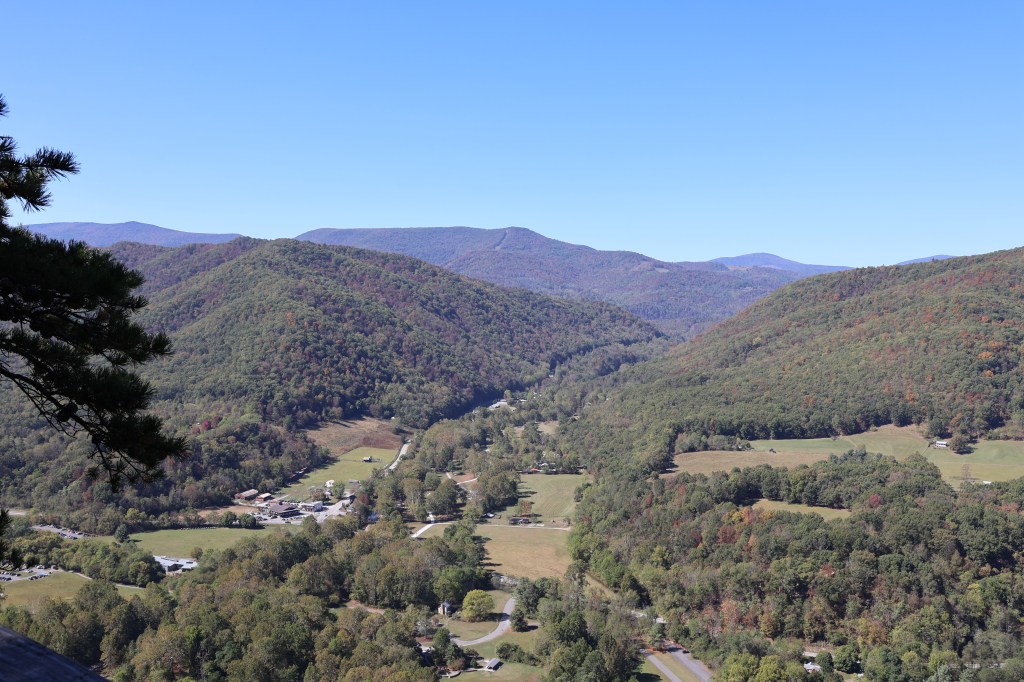

We cautiously made our way onto the rocks themselves, mindful of the signs about people falling to their deaths. I have a stupid fear of heights, so I stuck to the middle and crawled ungracefully on all fours. A flat-ish rock became a good place to sit and have a snack. I was content with a crumbly granola bar, but my partner pulled out his beef jerky. I’m too much of a raised-nearly-vegetarian city slicker to understand jerky. Growing up, it was something we fed our dog as a treat, not something to chew on while hiking. I also didn’t fully understand why preparing meat in a certain way means it doesn’t have to be refrigerated (seems fake and I didn’t trust it).
“I never knew people actually ate beef jerky until recently,” I admitted. “It was always something we gave to our dog.”
“What? Beef jerky’s great.” I was skeptical. He fondly recalled getting a pack in his stocking for Christmas one year, only for his parent’s dog to break into his room and get to it that afternoon. I said she probably didn’t appreciate him stealing her treats. I scratched his head like a dog’s. “Wanna fetch? Want another treat?” I teased.
The jagged rocks were crawling with other people, also looking for a scenic place to relax or have a bite to eat. I waited while my boyfriend explored the narrower and steeper sections of the rocks that I was too chicken to even look at. I carefully stored my camera and binoculars in my backpack on the way down, lest I dislodge them with a rock or knee.


We took a break at the warning sign to strategize for the rest of the day. My boyfriend took the opportunity to read the sign aloud.
“You know, only 15 people dying on these rocks doesn’t seem so bad. I mean, how many people hike here a day? This is only encouraging me to take more risks,” he remarked. In perfect comedic timing, he immediately misstepped and came crashing down on my backpack, nearly toppling us both. I unhelpfully reminded him to be careful, as if he had a time machine and could rewind three seconds, after which we both burst out laughing.

The trek down brought us by a flock of four warblers, fluttering at the top of a tree. I only saw them after a series of high-pitched bird noises made me stop and look up. I made note of as many details as I could, which wasn’t much, and took a good number of bad pictures. I couldn’t tell if they were all the same species (probably not). The bird I got the best looks at was relatively hefty, with the tell-tale pointed beak of a warbler. Its underside was uniform and pale, save for some light streaking on the sides and long, dark wings. I noticed bold white wing bars, but that alone wasn’t an identifying characteristic. I didn’t get a good look at the face. I left it unidentified for the weekend, but later puzzled over all my pictures and notes for probably an hour after returning, using a field guide and multiple different All About Birds tabs on my computer. If my pictures were brighter, the warbler’s orange feet would’ve tipped me off sooner, but I made sure to go over all the characteristics in case it was just a trick of the lighting. Blackpoll Warbler, an incredible long-distant migrant on its way to South America!
Back near the trailhead, my partner patiently waited while I studied a Cape May Warbler, snapping a photo of it with a spider in its mouth. While I didn’t get a photo, I also saw a lifer female Black-throated Blue Warbler, the subtle face pattern and white wing triangle a much-needed softball in the world of non-breeding warbler ID.
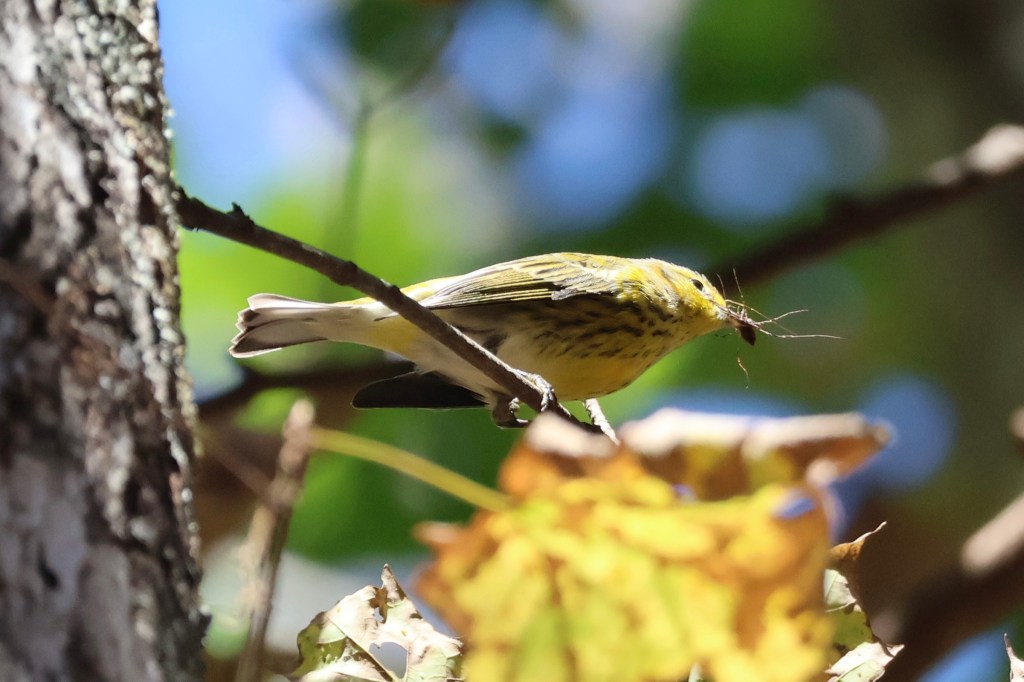
We made the short drive to the same shop we’d visited last night, right at the base of Seneca Rocks. It was wooden and quaint in the daylight, joined by a restaurant, gift shop, and climbing school. I used their Wi-fi to update my friends and family on my whereabouts, then stopped at a picnic table so we could eat lunch—ham and cheese sandwiches.

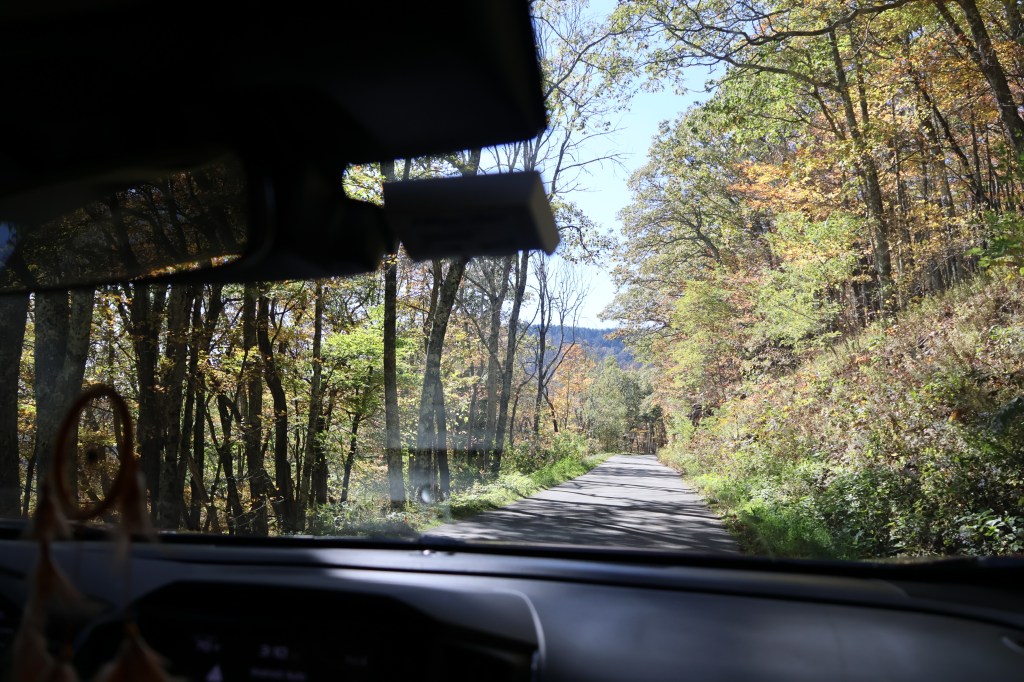
Our next destination was back the way we came, to the top of Spruce Knob. My feeble attempt to capture the beauty of the road on camera was unsuccessful. No matter how many ways I angled the camera or adjusted the settings, my dirty windshield caused a weird glare and the trees looked a lot greener and less impressive. I even made my partner pull over so I could get out and photograph the road, which looked very much like an average forest road in pictures. I couldn’t capture the way dust particles danced in the yellowy autumn air, or the gentle pirouetting of dying leaves as they made their way to the forest floor. Though that didn’t stop me from trying the whole rest of the drive.
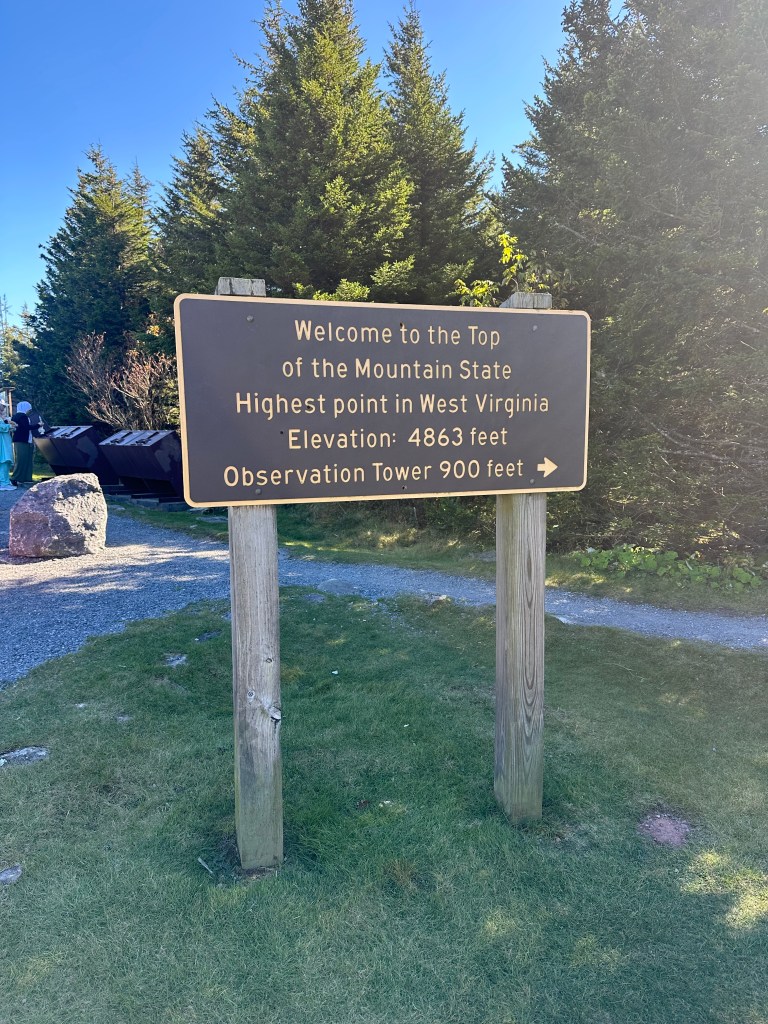
The sign at the top of Spruce Knob made me genuinely laugh out loud. “This is the highest point? And West Virginia is called the mountain state?!” I asked incredulously.
“Be nice,” my boyfriend reminded. I still texted a picture to my family, getting two laugh reactions and a text from my mom asking if I could breathe ok at that altitude.
Mountains out east are old, much older than anything I could comprehend. Supposedly once as tall as the Himalayas, millions of years of wind and rain had shaped them into gentle ridges and valleys, even the tallest peaks blanketed in trees. They stood over the East Coast like a sweet old grandpa—full of wrinkles and stooped with age. They no longer boast the same rugged peaks or impressive heights as their Western counterparts.
I was still shocked to find West Virginia’s highest peak sitting at 4,800 feet, over a thousand feet lower than the site we’d camped in Yosemite. That number would need an extra 1 at the front to compare to California’s Mt. Whitney or Washington’s Mt. Rainier.
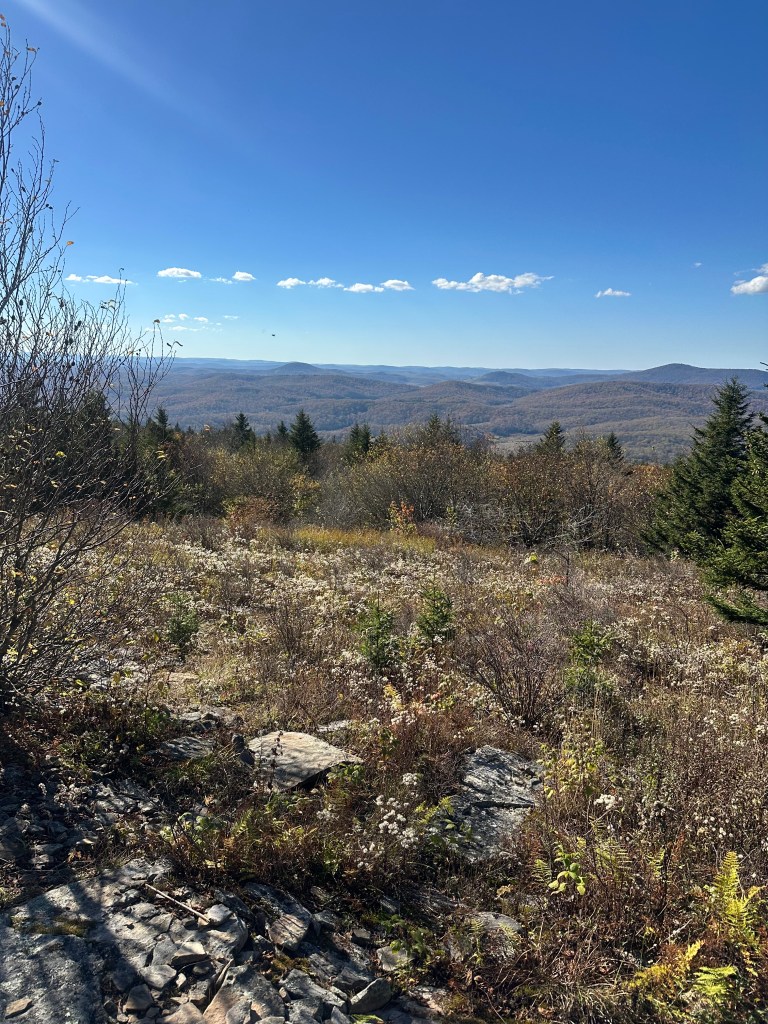
Stunted spruce trees and rocky terrain greeted us on the walk to the lookout point. Dark-eyed Juncos flitted through the undergrowth, flashing their white tail feathers. They lacked the same dark head and brownish wash of the juncos I was used to, instead uniformly gray, though their erratic movements were the same. A U.S. Geological Survey disc marked the actual highest point with a stamp of metal.


We were standing around yet another viewpoint when a woman with a nose ring and tie-dye graphic tee made eye contact. “You guys wanna see something cool?” She asked. I hesitated for a second, unsure if she was talking to me. “Oh. Sure?” She immediately whipped around and started scrambling down a slope of precarious rock slabs. My boyfriend and I carefully followed, rocks grinding and shifting underfoot, as she introduced herself and her wife.
A seemingly impenetrable wall of trees and bushes was all we found at end of the descent. It took several minutes of pacing back and forth, pushing our way through branches, to figure out where we were going.
“Is this it?” She asked under her breath. “No—wait. Sorry. I have holes in my brain, guys,” the woman explained, switching directions again. Maybe my survival instincts are poor, but she seemed too friendly to be a murderer or kidnapper, so I didn’t question it when they led us straight into the woods, where we found something slightly resembling an overgrown pathway.
The four of us emerged in a large field, strewn with boulders and dead grass, opening towards an expansive view of the valley. “C’mon babe, let’s frolic.” The woman and her wife waved us goodbye as they joined hands and skipped away.

The field was much less crowded than the viewpoint above. We took our time exploring the edges, following another path that abruptly ended in a meadow of little white flowers. After making our way back up, we got a family to take our photo, in exchange for a few photos of themselves. We overlooked the Allegheny Plateau, which stretched westward as far as I could see, helpfully explained by a well-placed sign.
Though it was only 5pm, we agreed to spend the rest of the afternoon back at the campground. My boyfriend strung up his hammock while I sat by the fire pit, engrossed in my new book about the Appalachian trail. A curious Hermit Thrush landed on an adjacent log to see what I was reading. I used my binoculars to admire his delicate freckles, rounded figure, and dusty brown back, reminded of another Hermit Thrush in Seattle that joined me while I read in a garden. Maybe they’re looking for bookworms. He scurried into the undergrowth as soon as I reached for my camera.
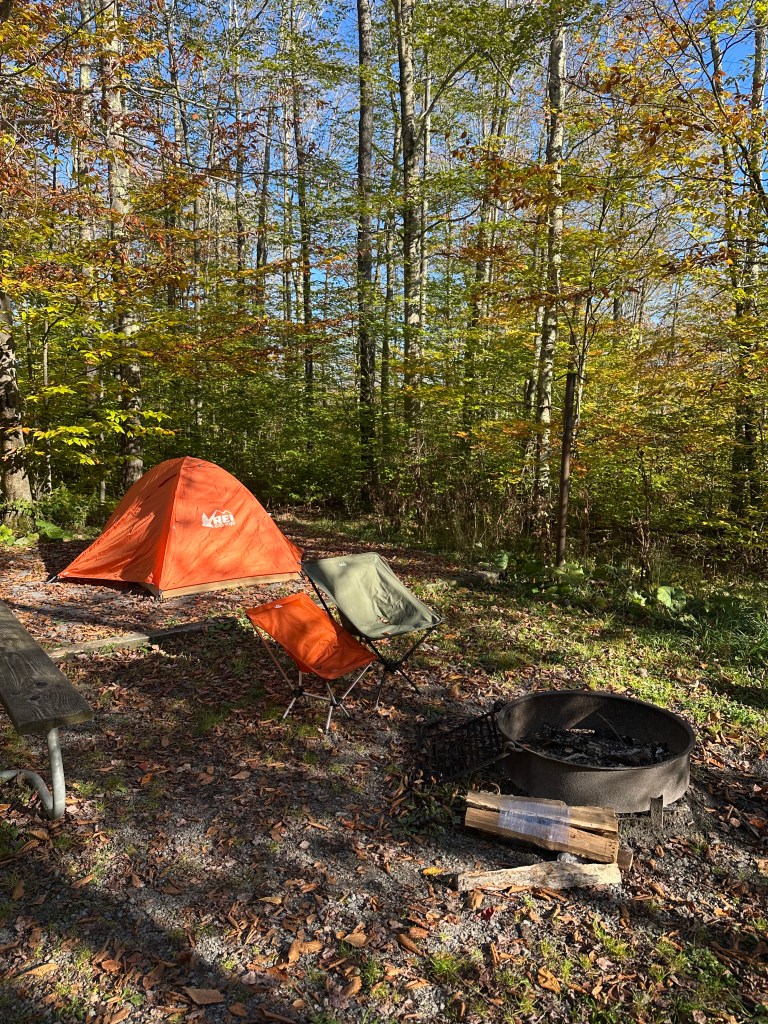
After 100 pages and a couple breaks to investigate bird sounds, the lazy afternoon was fading into evening. My partner chopped firewood while I watched helpfully from my chair. I was great moral support as he built the fire and boiled pasta on the stove for dinner—my contribution was to set the table, lean over his shoulder to see what he was doing, and point out all the birds we could hear from our campsite.
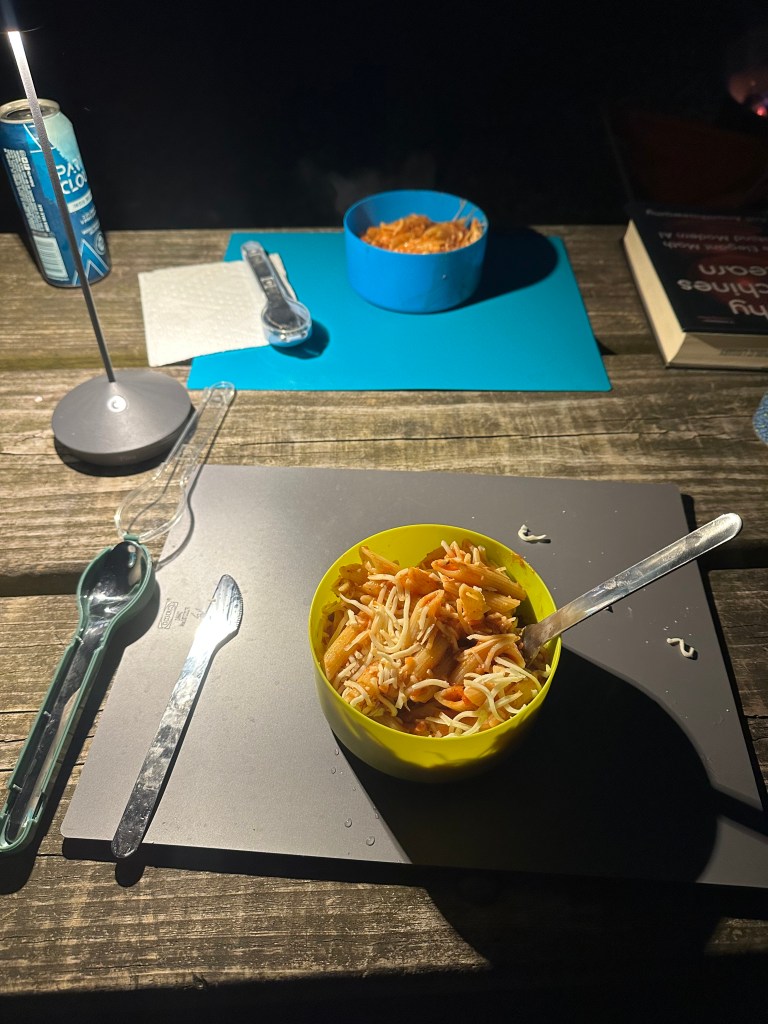
I’m pretty useless at cooking and eat butter noodles (sometimes with cheese) probably more often than I should. My boyfriend instead used something called “marinara sauce” and “spices” for a much more interesting dinner, which we ate happily in the dark. A Barred Owl hooted “who cooks for you!” from the woods bordering our campsite, a silly question, because if he was paying attention he’d already know the answer. The moonlight was nearly bright enough to not need a lantern as we cleaned up. We spent the rest of the evening chatting, drinking beer, and listening for more owls, before eventually retreating to our tent for the night.

Day 3
This time, I did not wake up at 6:30am freaking out about poorwills. But I did wake up early. I have a nasty habit of escaping my sleeping bag, finding some way to crawl out the top in the middle of the night and then wake up freezing cold. I fished a hand warmer out of my backpack so I could warm up enough to fall back asleep until a reasonable hour.
At around 8, I finally mustered up the courage to get dressed and get up for good. A spider crawling on the inside of the tent was enough to get me moving. I got him out without crying or screaming even once (I’m scared of spiders), so I was feeling pretty proud.
We had another slow morning of coffee, leftover french toast, and scrambled eggs. I was put in charge of monitoring the pot of water while my boyfriend went to the bathroom, but ended up at the far end of the campsite with my binoculars by the time he came back.
“The water’s boiling,” he said.
“What! I checked a minute ago. I promise it wasn’t boiling then. I’m paying attention,” I said, hurriedly getting out the coffee and preparing the french press. During breakfast, once again, I was distracted by some kind of thrush that flew into the bushes by our table. I desperately tried to get a good look at it, but lost it in the tangle of branches. With my luck, it was probably a Gray-cheeked Thrush, and I’d never see one again. It’s fine.
“You know, this was the perfect weekend for us to go camping, because the Bills game isn’t until 8 tonight. I’ll still be back in time to see it,” my boyfriend said thoughtfully as we did dishes. I glared at him and he backpedalled. “Wait but, to be clear, I would’ve missed the Bills game for a weekend with you. Babe.” I tried to keep looking mad, but couldn’t help but laugh.
“Well, today I’m missing a four hour bird rehab class, put on by the Northern Virginia Bird Alliance. All for you,” I joked.
“What noble sacrifices we make for each other.” I nodded in agreement.
It was Sunday, so we had to dismantle our campsite once we were finished with breakfast. The hike we wanted to do was an hour in the Virginia direction, so we planned to pack up the car for good and drive straight home from the trailhead. It’s a lot easier to take apart a campsite with a second set of hands. The whole process went fairly smoothly and quickly. We admired the campground one last time and began our final journey down the side of the mountain. Determined to not make the same mistake as yesterday, I was extra-alert for potholes, which is when movement on the side of the road caught my eye.
“Squirrel! No. Bird? Crow?” I squinted at the shadowy figure and made out a small, mohawked head. “GROUSE? RUFFED GROUSE??” I screamed and slammed on the brakes, the dishes rattling noisy in the back. I fumbled one-armed for the backpack with my binoculars, not wanting to take my eyes off the little guy. “The grouse—it’s a Ruffed Grouse. Oh my god. Do you see him? WHERE ARE MY BINOCULARS? Look! Do you see him??”
Once I finally got ahold of my binocs, I leaned out my window and aimed them through the trees. He was poking around a tree log, coming in and out of view, head bobbing. The scale-like feather pattern on his sides matched the backdrop perfectly when he held still. Plump and chicken-like, he was adorable.
My partner and I took turns watching him through binoculars until he disappeared into a thicket. Still parked in the middle of the road, I giddily reported him on eBird, with the unhelpful description “LETS GOOO” in all caps. I know the regional reviewers hate me. He was the only highlight on our otherwise peaceful drive of weaving around potholes and admiring the fall scenery, though I was secretly keeping my eyes peeled for another grouse.
Today’s hike, though not terrible, was harder then yesterday. Five miles roundtrip, it was a simple out-and-back, straight up the side of a hill. The higher we climbed, the more our scenery changed—I was once again enjoying the familiar feel of it all. The woods thinned and became predominantly evergreen, with manzanita-like shrubbery outlining the rocky trail. The sweet, pungent smell of dirt and sap filled the air. It wasn’t long before a warbler’s trilling stopped us in our tracks. My mind jumped to Orange-crowned or Wilson’s, though I knew it wasn’t either. He wouldn’t cooperate with my attempts to identify him, perching behind branches and not making another peep, before flying off.

I knew I had enough details to puzzle it together. Large, yellowish, no visible streaking, trilling call… my boyfriend waiting while I perused all the possibilities, mumbling to myself. I was pretty confident I could match its call with a recording, so I was playing through a couple of them on low volume and holding my phone up to my ear. “Maybe you can play a bunch of songs and see which one he responds to,” my boyfriend suggested.
“That’s actually a real thing people do called playback,” I told him. I thought about launching into a long-winded explanation on the ethics of playback and its history, but I spared him the lecture. I would just keep my volume low and stop once I found a match. There weren’t a ton of warblers I thought it could be, so it wasn’t long before I played the trill of a Pine Warbler. Before I could triumphantly declare an ID, we heard the warbler’s distant reply, a perfect confirmation.
About halfway up, we stopped at a viewpoint, greeting another hiker who’d stopped there too. We made inane comments about the weather, then shared stories about other hikes we’d done. It was a good thing my boyfriend was there, because I’m still learning my local geography. I very confidently mistook the hiker’s hometown for a place in Pennsylvania, rather than the almost-identically-named town in Virginia. The hiker mentioned a lot of town names ending in “-ville” and “-burg” then expectantly waited for a sign of recognition, so I let my boyfriend handle that, while I stood there smiling blankly and nodding.
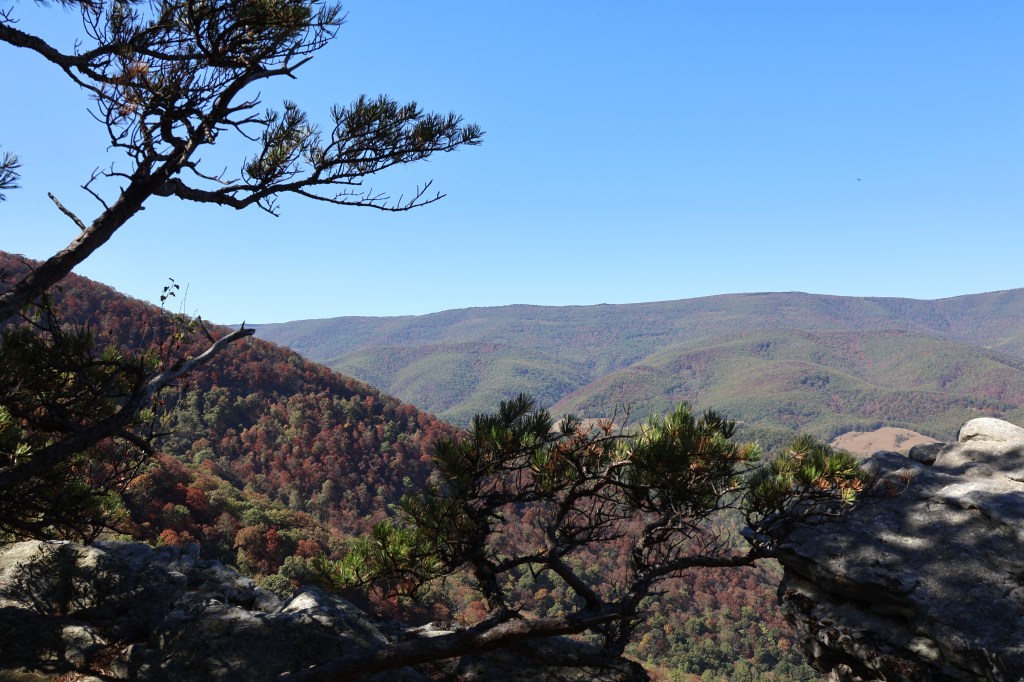
After we’d caught our breath and stopped sweating, we wished him a good rest of his hike and began the steep ascent to the top. We did some scrambling up tree roots and loose rocks, fighting with overgrown bushes, before we could finally see blue sky through the trees ahead.
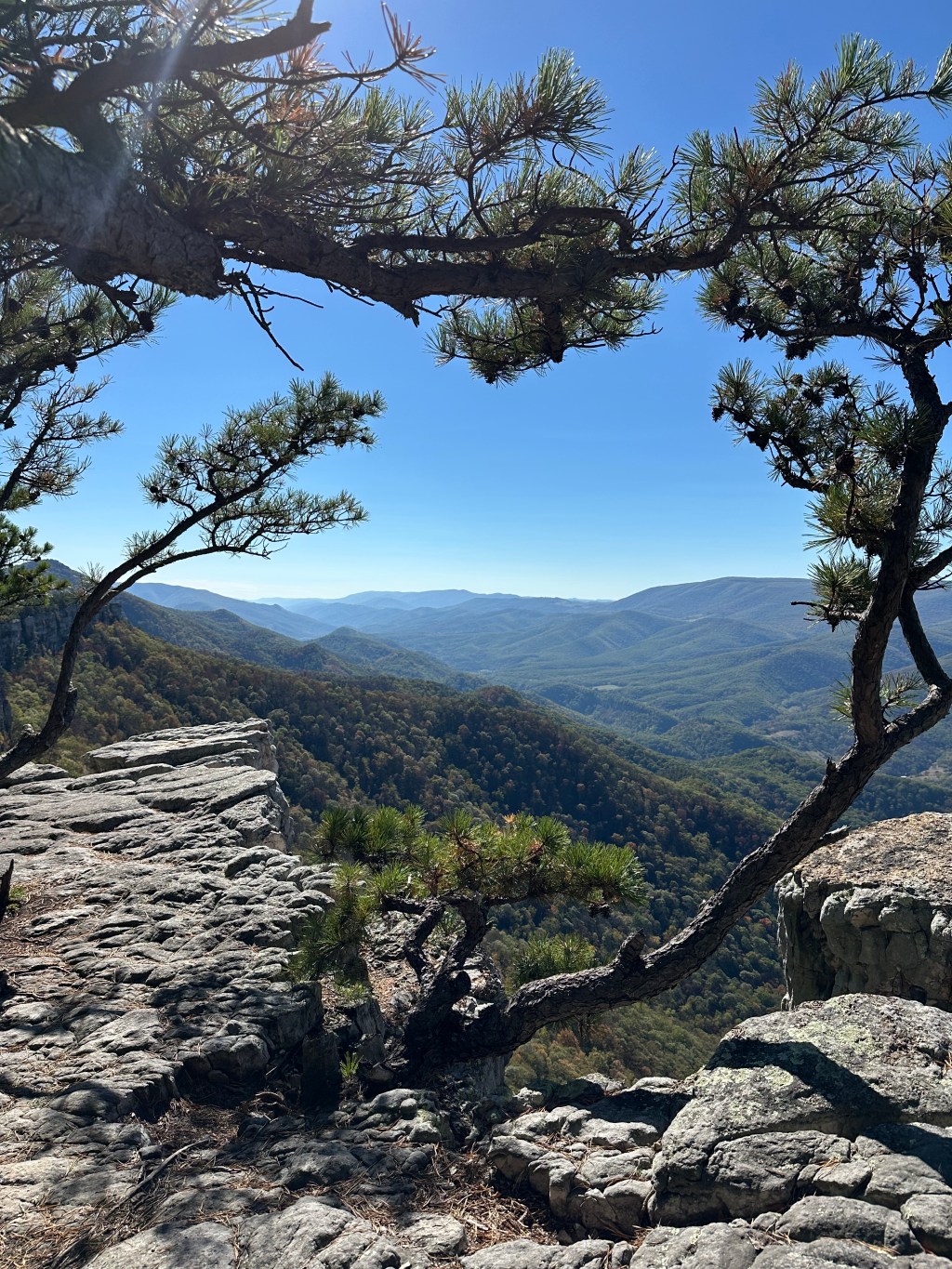
Online comments about Chimney Top being “worth it” and “a hidden gem” weren’t kidding. The view from the top was absolutely incredible, and considerably less crowded than Seneca Rocks or Spruce Knob. Nothing tastes better than a ham and cheese sandwich with a view, so we shed all our gear and perched on top of a rock to enjoy lunch. We took our time to eat and chit-chat and debrief the weekend.
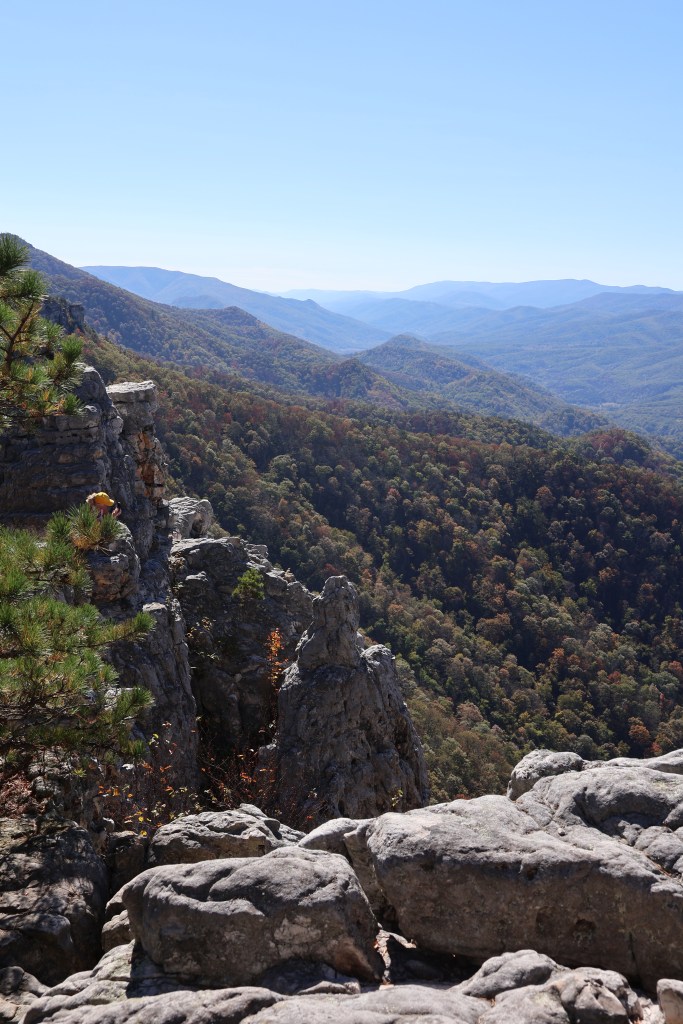
I shared in earnest how pleasantly surprised I was by West Virginia. It wasn’t really a state I’d ever thought about before, so I had no idea what was there or what to expect. The concept of “natural beauty” and “preservation” came up a lot. It’s interesting, because as we looked out at our view, it didn’t seem any less deserving of protection or appreciation as, say, Pinnacles National Park or Shenandoah National Park, though it received less recognition. But because the East Coast has fewer National Parks, a lot of people—in all honesty, myself included—assume it’s less naturally beautiful than the West. Of course, this is partly due to the history of the National Park system, and the fact that it started out west and had to be brought eastward to an already heavily populated coast. Regardless, it still often (incorrectly) serves as a benchmark of what lands are deserving of visiting and protecting.
Although we lamented the number of outdoors enthusiasts who would never step foot in West Virginia and experience the same scenic vistas, we were also grateful for the lack of crowds. For a brief moment, I was able to stop comparing the landscape with the West Coast. It was simply different, and that didn’t mean better or worse. It’s unfair to compare Chimney Top with Yosemite because one is taller, but the other is older and more biodiverse, but the other is less densely populated… and so on. Nobody that truly appreciates the natural landscape can honestly say that Yosemite is “better.” A breathtaking view is a breathtaking view, and the sense of awe and appreciation you feel shouldn’t be diminished by the existence of other beautiful landscapes.
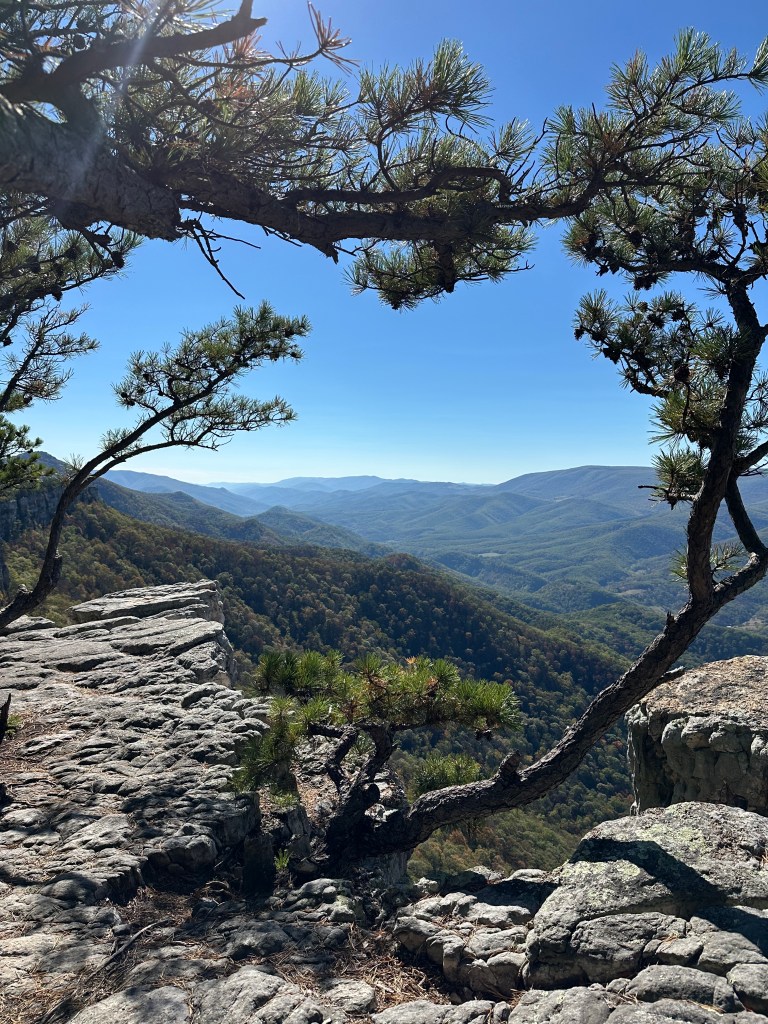

Like a lizard, I would be perfectly content to bask in the sun and lay on the warm rocks all day. But lizards aren’t bound by work and responsibilities. With lots of grunting and complaining, I dragged myself to my feet. We said hello to our not-Pennsylvania friend again, who was relaxing on another rock cluster, and offered to take a picture for a large group of women.
“Oh, I should’ve brought my binoculars,” one of them commented, her eyes fixed on my pair. “Well, I remembered to pull them out, but my stupid husband forgot to pack them!” The group erupted in screeching laughter. Even after I returned their phone and we began our descent through the trees, we could hear them shrieking intermittently, reminiscent of a flock of Blue Jays.
Covered in grime and sweat, we made it back to the car unscathed. After one last ritual of shaking dirt from our hiking boots and checking on our camping supplies, we were ready to return to civilization, tired but happy.
 Summer Delehanty's Portfolio